| Johannesburg, South Africa - May 21, 2026
How to Build SEO Content That Ranks Beyond One Keyword in Johannesburg, South Africa
SEO content should not be built around one keyword only.
Search behavior has become more complex. Users ask different questions, use different phrases, compare options, and search with different levels of intent. A page that focuses only on one exact keyword may miss many opportunities to rank for related searches.
For businesses operating in South Africa, building SEO content that ranks beyond one keyword can improve visibility, traffic quality, and long-term digital performance. In South African market, users search in different ways, which means content must cover the full topic, not only one phrase.
This is why businesses invest in search engine optimization strategies that improve content structure, search intent alignment, and organic visibility.
Strong SEO content ranks for topics.
Not just keywords.
What Ranking Beyond One Keyword Means
Ranking beyond one keyword means creating content that can appear for multiple related search queries.
Instead of targeting one phrase only, the content is built around a broader topic and the different ways users search for it.
This can include:
- primary keywords
- related keywords
- long-tail phrases
- question-based searches
- user intent variations
- subtopics
- comparison searches
- problem-based searches
- service-related searches
- location-based searches
The goal is to create content that answers the topic fully.
When content is complete and well structured, it has more chances to appear across different searches.
Why One Keyword Is Not Enough
One keyword is rarely enough because users do not all search in the same way.
Some users search with short terms. Others search with questions. Some are looking for information, while others are ready to compare or buy.
Focusing on one keyword only can limit:
- organic reach
- ranking opportunities
- content depth
- search relevance
- user engagement
- long-term visibility
- conversion potential
- topic authority
For businesses in South Africa, stronger SEO content should support different stages of the user journey.
The best content answers the full search need.
Single Keyword Content vs Topic-Based Content
Single keyword content is limited.
Topic-based content is stronger.
The difference is clear:
- single keyword content targets one phrase
- topic-based content targets a full search area
- single keyword content may feel shallow
- topic-based content provides deeper value
- single keyword content can miss related searches
- topic-based content captures more variations
- single keyword content focuses on ranking
- topic-based content focuses on usefulness
- single keyword content may become outdated faster
- topic-based content builds authority
Search engines reward helpful content that answers user needs clearly.
A strong topic gives content more room to rank.
Why Many SEO Pages Fail to Rank Broadly
Many SEO pages fail because they are written only around keyword repetition.
They include the keyword but do not fully answer what users need. This creates content that may look optimized but does not perform well over time.
Common problems include:
- thin content
- keyword stuffing
- weak structure
- unclear search intent
- missing subtopics
- no internal linking
- poor headings
- generic explanations
- lack of helpful examples
- weak user experience
These issues reduce the ability of a page to rank for multiple searches.
SEO content should be useful before it is optimized.
How to Build SEO Content That Ranks Beyond One Keyword
Building SEO content that ranks beyond one keyword requires strategy, structure, and depth.
Start With Search Intent
Search intent is the reason behind a user’s search.
Before writing, businesses need to understand what the user wants to achieve.
Search intent can include:
- learning about a topic
- comparing solutions
- finding a service
- solving a problem
- making a decision
- buying a product
- checking credibility
- finding local options
When content matches search intent, it becomes more relevant.
Relevance improves ranking potential.
Build Around a Full Topic
A strong SEO page should cover the topic in depth.
This does not mean making the content unnecessarily long. It means answering the important questions users may have.
A topic-based page may include:
- definition
- importance
- benefits
- common mistakes
- how it works
- examples
- comparison points
- decision factors
- frequently asked questions
- next steps
This connects with content strategy development that aligns topics, messaging, and audience intent.
When the page covers the topic well, it can rank for more related searches.
Use Related Keywords Naturally
Related keywords help search engines understand the full context of the page.
They also help the content match different ways users search.
Related keywords can include:
- synonyms
- service terms
- question phrases
- problem phrases
- solution phrases
- industry terms
- location terms
- comparison terms
These should be used naturally.
The goal is not to force keywords into the content.
The goal is to write in a way that fully explains the topic.
Create Strong Headings
Headings help both users and search engines understand the page.
A strong heading structure makes content easier to scan and easier to index.
Good headings should:
- organize the topic clearly
- answer user questions
- include relevant terms naturally
- guide the reading flow
- support subtopics
- improve readability
Headings should not be random.
They should create a clear content journey.
Answer Questions Clearly
Question-based content can help pages rank for more search queries.
Users often search using questions, especially when they are learning or comparing.
Useful questions can include:
- what is it?
- why does it matter?
- how does it work?
- when should it be used?
- what are common mistakes?
- how can it improve results?
- what should businesses consider?
Answering questions clearly improves the usefulness of the page.
It also supports long-tail search visibility.
Search Intent and Content Depth
Content depth should match the user’s intent.
A simple question may need a direct answer. A complex topic may need a deeper guide.
Businesses should avoid two extremes:
- content that is too shallow
- content that is long but repetitive
Strong content gives enough detail to satisfy the search.
It should help users understand the topic and know what to do next.
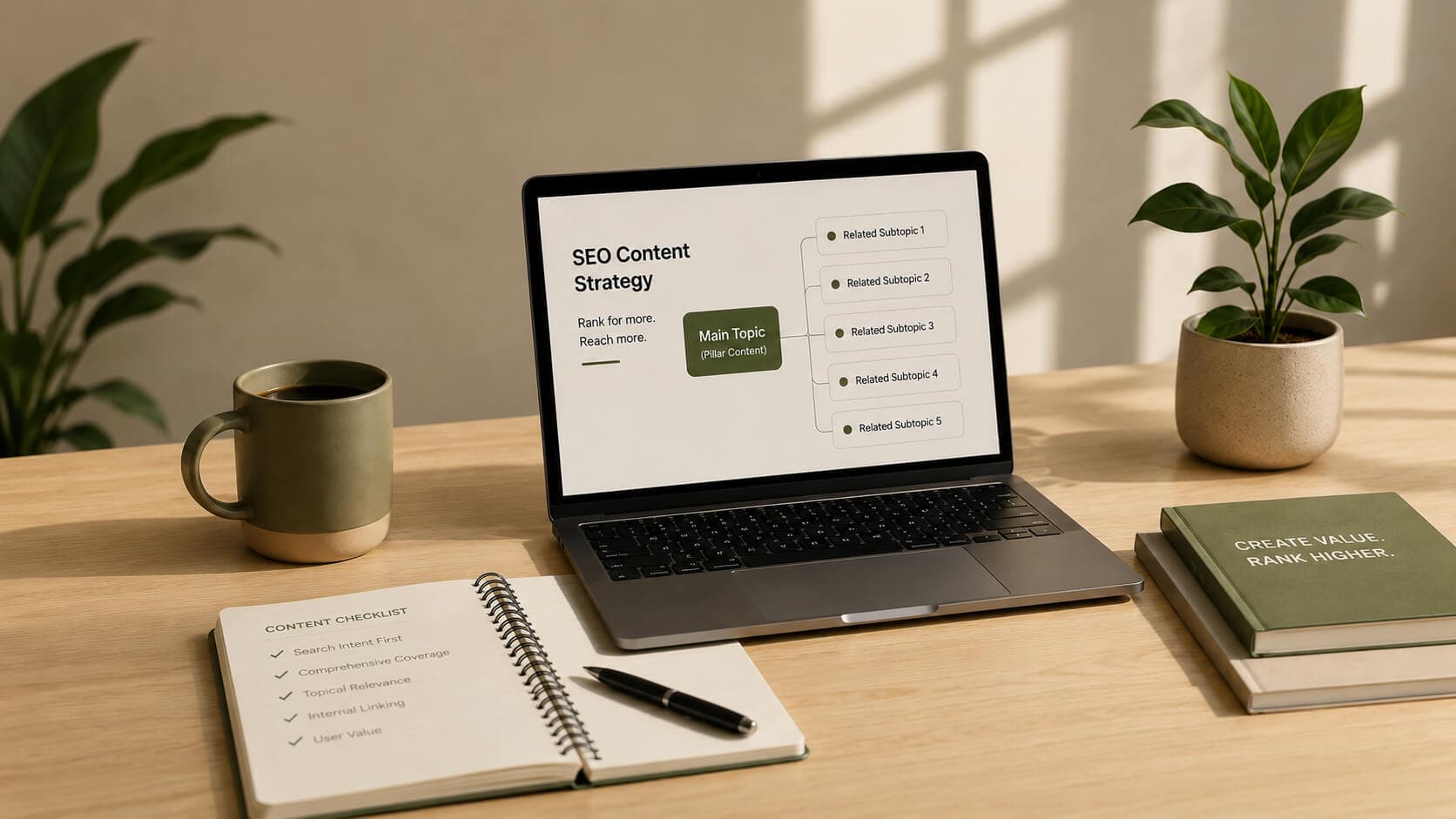
Topic Clusters and SEO Growth
Topic clusters help build SEO strength beyond one page.
A topic cluster is a group of related content pieces connected around a main topic.
For example, a business may create a main SEO service page and support it with blogs about:
- keyword strategy
- technical optimization
- local search
- content optimization
- website structure
- search intent
- organic traffic
- analytics
This helps build authority around the topic.
It also improves internal linking and content relevance.
Internal Linking
Internal linking helps connect related pages across a website.
It supports both user navigation and search engine understanding.
Strong internal linking can help:
- guide users to related content
- distribute page authority
- improve crawlability
- connect service pages and blogs
- support topic clusters
- improve session depth
This aligns with website development strategies that improve structure, navigation, and SEO performance.
Internal links should feel helpful, not forced.
They should guide users naturally to the next relevant page.
Content Structure and Readability
SEO content must be easy to read.
Even strong information can fail if the structure is difficult to follow.
Readable content includes:
- short paragraphs
- clear headings
- logical flow
- simple explanations
- useful lists
- focused sections
- clear transitions
- direct answers
Good readability improves engagement.
Engagement can support stronger SEO performance because users stay longer and interact more with the page.
Writing for Users First
SEO content should always be written for people first.
Search engines are designed to reward useful content. If the content is written only for algorithms, it may feel unnatural and weak.
User-first content should be:
- clear
- helpful
- specific
- relevant
- easy to understand
- aligned with user needs
- structured around real questions
- connected to business goals
Good SEO writing balances visibility with value.
The user must benefit from the content.
Avoiding Keyword Stuffing
Keyword stuffing happens when a keyword is repeated too often in an unnatural way.
This makes content harder to read and can reduce quality.
Instead of repeating one keyword, content should use:
- natural phrasing
- related terms
- clear explanations
- helpful examples
- topic-based structure
- user-focused language
Keyword use should support the content.
It should not control it.
Updating Existing SEO Content
SEO content should be reviewed and updated over time.
Search behavior changes, competitors publish new content, and user expectations evolve.
Content updates can include:
- adding new sections
- improving headings
- updating examples
- refining keywords
- adding internal links
- improving readability
- expanding FAQs
- refreshing meta titles and descriptions
Updated content can maintain or improve rankings over time.
SEO is not a one-time task.
It is an ongoing process.
Common SEO Content Mistakes
Many businesses lose ranking opportunities because their content is too narrow or poorly structured.
Common mistakes include:
- targeting only one keyword
- ignoring search intent
- using vague headings
- writing thin content
- repeating keywords too much
- missing related questions
- not using internal links
- ignoring readability
- not updating content
- creating content without strategy
These mistakes limit visibility.
Better content strategy creates stronger ranking potential.
When Businesses Should Improve SEO Content
Businesses should improve SEO content when pages are not ranking well or traffic is not converting.
This is especially important when:
- pages rank for few keywords
- traffic is low
- users leave quickly
- content feels outdated
- competitors rank better
- search intent is unclear
- service pages are weak
- blogs do not support business goals
- competition is increasing in South Africa
Improving content can help businesses capture more organic visibility.
A better page can rank for more than one search.
Strategic Reality Behind SEO Content
SEO content is not about writing for one keyword.
It is about building relevance around a full topic.
A strong SEO content strategy should answer:
- what does the audience want to know?
- what search intent should the page satisfy?
- what related terms should be included?
- what subtopics are important?
- what questions should be answered?
- what internal links should support the page?
- how should the content guide users?
- how does the page support business growth?
When these questions are answered, content becomes more strategic.
It can rank more broadly and perform more effectively.
Real World Application
A business in South Africa building SEO content beyond one keyword can improve organic reach and attract better traffic.
A strong SEO content page can help the business:
- rank for multiple search terms
- answer more user questions
- improve search visibility
- build topic authority
- increase website traffic
- support service pages
- improve user engagement
- generate better leads
For example, instead of writing a page only around one keyword, a business can create a full guide that covers definitions, benefits, examples, common mistakes, related questions, and service relevance.
This creates a stronger page with more ranking opportunities.
SEO Content and Growth
Businesses scaling in South Africa, including Johannesburg, Cape Town, Durban, Pretoria and beyond, benefit from SEO content that is structured around topics and user intent.
As competition increases, shallow content becomes less effective. Strong content needs depth, clarity, structure, and relevance.
SEO content supports growth by helping businesses create:
- stronger organic visibility
- better search relevance
- higher quality traffic
- improved website authority
- more useful content journeys
- stronger internal linking
- better conversion opportunities
- long-term digital value
Growth needs content that performs beyond one keyword.
Topic-based SEO helps make that possible.
Expert Perspective from The iBoost
At The iBoost, we create SEO content strategies that focus on search intent, topic depth, structure, and long-term visibility.
We help businesses move beyond single keyword targeting and build content that answers real user needs while supporting business growth.
Through search engine optimization strategies that improve content structure, search intent alignment, and organic visibility, we help businesses build stronger content across South Africa.
SEO content that ranks beyond one keyword is built around relevance, clarity, and depth.
For businesses in South Africa, this approach can improve visibility, traffic quality, and long-term organic growth.
Frequently Asked Questions
It means creating content that can appear for multiple related search queries, not only one exact keyword.
One keyword is not enough because users search in many different ways, including questions, comparisons, long-tail phrases, and related terms.
Content can rank for more keywords by covering the topic fully, matching search intent, using related terms naturally, answering questions, and using strong structure.
Search intent is the reason behind a user’s search, such as learning, comparing, solving a problem, or making a purchase decision.
Internal links help connect related pages, guide users, improve website structure, and support topic authority.