| Baghdad, Iraq
Digital Marketing vs. Traditional Marketing: Which One Delivers More Value in Iraq
Marketing has evolved significantly over the years.
Traditional marketing methods such as print, TV, radio, and billboards have helped brands reach audiences for decades. However, digital channels have changed how businesses communicate, measure performance, and optimize campaigns.
For businesses operating in Iraq, choosing the right marketing approach is critical for maximizing impact and return on investment. In Iraqi market, businesses need strategies that are measurable, flexible, and aligned with audience behavior.
This is why companies invest in digital marketing strategies that improve targeting, performance tracking, and measurable results.
The question is not which one exists.
It is which one performs better.
What Traditional Marketing Includes
Traditional marketing refers to offline marketing channels that reach audiences through mass media and physical placements.
Traditional marketing can include:
- TV advertising
- radio
- print media
- billboards
- flyers
- brochures
- magazine ads
- newspaper ads
- outdoor advertising
- event sponsorships
These channels are often used for broad awareness and visibility.
They can help brands reach large audiences, but they are usually harder to track and optimize compared to digital channels.
What Digital Marketing Includes
Digital marketing refers to online strategies used to reach, engage, and convert audiences through digital platforms.
Digital marketing can include:
- search engines
- social media
- paid ads
- content marketing
- email marketing
- SEO
- search engine marketing
- display advertising
- influencer marketing
- retargeting
- website optimization
- video marketing
Digital marketing gives businesses more control over targeting, measurement, and optimization.
It allows campaigns to be adjusted based on real performance data.
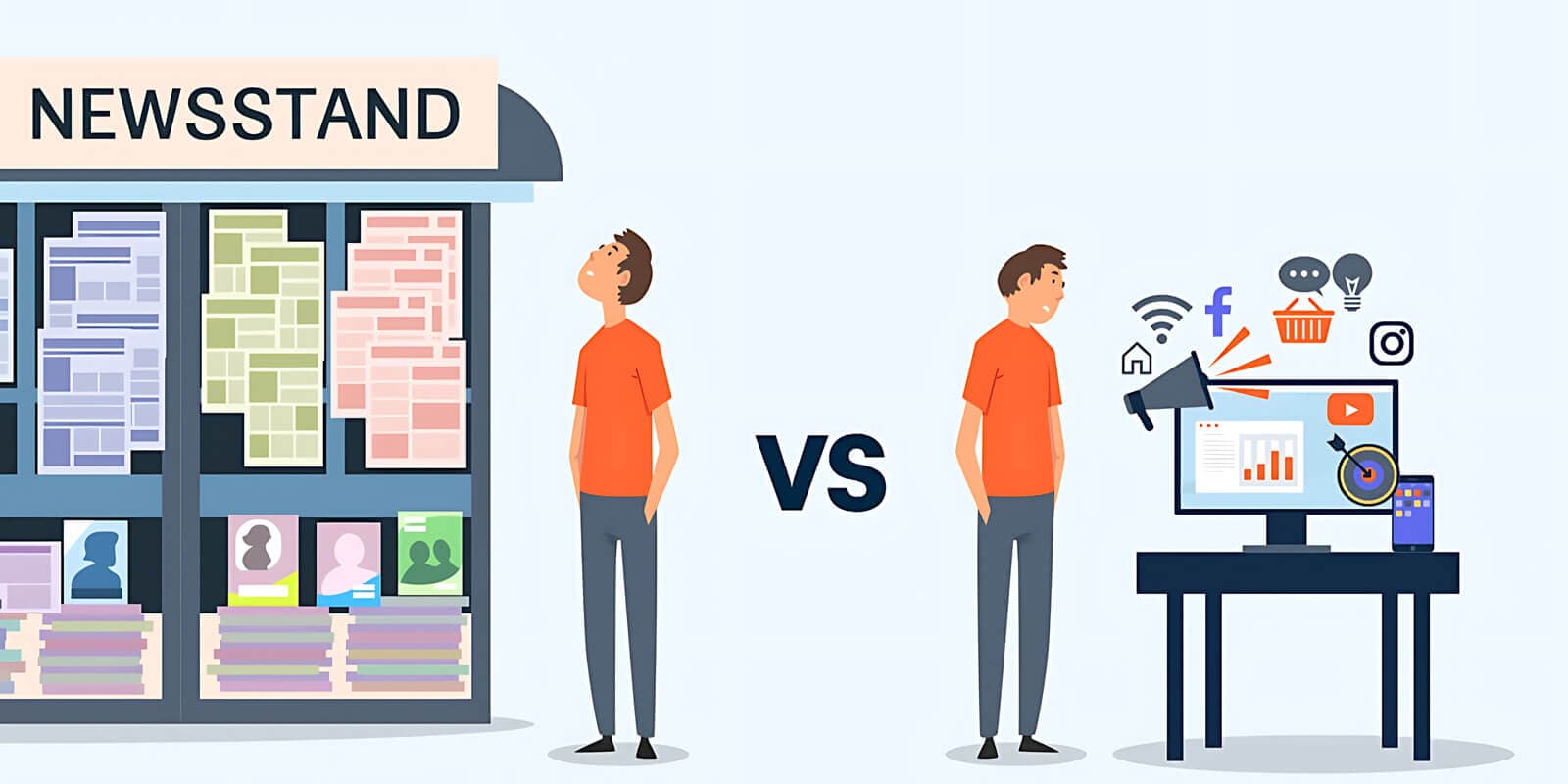
Digital Marketing vs Traditional Marketing: Key Differences
Digital marketing is measurable.
Traditional marketing is harder to track.
Digital marketing is targeted.
Traditional marketing is broad.
Digital marketing is flexible.
Traditional marketing is fixed.
The difference is clear:
- digital marketing tracks performance in real time
- traditional marketing provides limited tracking
- digital marketing targets specific audiences
- traditional marketing reaches broader audiences
- digital marketing allows campaign adjustments
- traditional marketing is harder to change once launched
- digital marketing supports personalization
- traditional marketing usually delivers one message to many people
- digital marketing can optimize budget
- traditional marketing often requires higher upfront costs
Both methods can create visibility.
However, digital marketing gives businesses more data, flexibility, and control.
Why Digital Marketing Delivers More Value
Digital marketing delivers more value because it helps businesses understand what is working and what is not.
Instead of spending budget without clear visibility, businesses can monitor performance, adjust campaigns, and improve results over time.
Digital marketing offers:
- better targeting
- real time analytics
- cost efficiency
- scalability
- higher engagement
- faster optimization
- clearer ROI measurement
- better audience insights
Across Iraq, businesses are shifting toward digital because it allows them to make smarter marketing decisions.
Digital marketing turns campaigns into measurable systems.
Better Targeting
One of the biggest advantages of digital marketing is targeting.
Businesses can reach users based on interests, behavior, location, demographics, search intent, website activity, and engagement level.
This allows campaigns to focus on the people most likely to take action.
Digital targeting can include:
- location targeting
- interest targeting
- demographic targeting
- keyword targeting
- retargeting audiences
- lookalike audiences
- behavior based targeting
- platform specific targeting
This helps reduce wasted spend and improve campaign efficiency.
Real Time Analytics
Digital marketing allows businesses to track performance in real time.
This means businesses can see how campaigns are performing and make improvements quickly.
Metrics can include:
- impressions
- clicks
- reach
- engagement
- website traffic
- leads
- conversions
- cost per click
- cost per lead
- return on ad spend
Traditional marketing can create awareness, but it is usually harder to know exactly which placement, message, or audience drove results.
Digital marketing gives businesses clearer insight.
Cost Efficiency
Digital marketing can be more cost efficient because campaigns can start with flexible budgets and scale based on performance.
Businesses do not always need large upfront investment to begin. They can test different messages, audiences, and platforms before increasing spending.
Cost efficiency improves through:
- better targeting
- campaign testing
- budget control
- performance tracking
- optimization
- retargeting
- conversion tracking
This makes digital marketing especially useful for businesses that want measurable growth.
Scalability
Digital marketing is highly scalable.
A business can start with a small campaign, analyze results, and expand what works. This allows marketing efforts to grow with the business.
Scalability can support:
- new markets
- new audiences
- more campaigns
- additional platforms
- increased budgets
- new services
- regional expansion
- long term growth
For businesses expanding in Iraq, scalability is a major advantage.
Digital marketing can grow as the business grows.
Higher Engagement
Digital marketing allows audiences to interact with brands directly.
Users can comment, share, click, save, message, subscribe, review, and respond. This creates two-way communication rather than one-way exposure.
Engagement can happen through:
- social media posts
- stories
- reels
- ads
- email campaigns
- website content
- videos
- polls
- direct messages
- comments
This aligns with [social|social media marketing strategies that improve engagement, audience interaction, and brand visibility.]
Higher engagement helps brands build stronger relationships with their audience.
When Traditional Marketing Still Works
Traditional marketing is not irrelevant.
It can still be effective when used strategically, especially for broad visibility, offline awareness, and local presence.
Traditional marketing can work for:
- mass awareness campaigns
- local visibility
- offline audience targeting
- event promotion
- retail visibility
- outdoor campaigns
- brand recognition
- community presence
For example, billboards can support local awareness, while TV or radio can reach broad audiences.
However, traditional marketing often works best when supported by digital campaigns that can track engagement and drive action.
Why the Best Strategy Often Combines Both
The best strategy often combines both traditional and digital marketing.
Traditional marketing can create awareness, while digital marketing can capture interest, retarget users, measure performance, and drive conversions.
A combined strategy can include:
- billboard awareness with digital retargeting
- event sponsorship with social media campaigns
- print ads with QR codes
- TV campaigns supported by search ads
- offline promotions linked to landing pages
- radio ads supported by paid social campaigns
Traditional marketing can create visibility.
Digital marketing can turn that visibility into measurable action.
Strategic Reality Behind Digital vs Traditional Marketing
The best strategy often combines both, but digital leads performance.
This is because digital marketing provides targeting, tracking, flexibility, and optimization that traditional marketing cannot easily match.
A strong marketing strategy should answer:
- who is the audience?
- where do they spend time?
- what message will influence them?
- which channels support the goal?
- how will performance be measured?
- how can campaigns be optimized?
- how will ROI be improved?
Marketing should not be based on habit.
It should be based on performance.
Real World Application
A business in Iraq using digital marketing effectively can improve campaign performance and make smarter budget decisions.
Digital marketing can help the business:
- improve ROI
- increase targeting accuracy
- optimize campaigns
- track performance
- reduce wasted spend
- improve engagement
- generate better leads
- support long term growth
For example, a business may use paid search to capture active demand, social media to build engagement, content marketing to educate audiences, and retargeting to bring users back.
This creates a connected marketing system.
Digital Marketing and Growth
Businesses scaling in Iraq, including Baghdad, Basra, Mosul, Erbil and beyond, benefit from measurable and scalable digital strategies.
As businesses grow, they need marketing systems that can adapt, track results, and improve continuously.
Digital marketing supports growth by helping businesses create:
- stronger targeting
- clearer performance tracking
- better budget efficiency
- higher engagement
- scalable campaigns
- improved conversion paths
- stronger customer insights
- long term visibility
Growth requires marketing that can be measured and optimized.
Digital marketing makes that possible.
Expert Perspective from The iBoost
At The iBoost, we help businesses build digital marketing strategies that improve targeting, tracking, and campaign performance.
We focus on measurable results, audience behavior, and continuous optimization so businesses can maximize impact and reduce wasted effort.
Through digital marketing strategies that improve targeting, performance tracking, and measurable results, we help businesses maximize impact across Iraq.
Digital marketing offers greater flexibility, targeting, and measurement compared to traditional methods.
For businesses in Iraq, prioritizing digital can improve performance, strengthen engagement, and support long term growth.
Frequently Asked Questions
Digital marketing uses online channels such as search engines, social media, paid ads, and content marketing, while traditional marketing uses offline channels such as TV, radio, print, and billboards.
Digital marketing often performs better because it offers better targeting, real time analytics, cost efficiency, scalability, and measurable results.
Yes. Traditional marketing can still be useful for mass awareness, local visibility, offline audience targeting, and brand recognition.
The best approach depends on the business goal, audience, and budget. However, digital marketing usually offers stronger tracking, flexibility, and performance optimization.
Yes. Traditional marketing can create awareness, while digital marketing can track engagement, retarget users, and drive measurable conversions.