| London, United Kingdom - Jul 06, 2026
Signs You Need a Website Redesign in London
A website redesign should not be based only on personal taste. The stronger reason to redesign is performance. If the website no longer helps people understand, trust, and contact the business, it may be holding growth back.
For businesses in London, the website is often the first serious place where customers evaluate the brand. If that experience feels weak, the business can lose opportunities before a conversation begins.
A redesign should not start with the question of whether the website looks nice. It should start with a more important question: is the website still doing its job? A website should help visitors understand what the business offers, why it is credible, what makes it different, and how to take the next step. When these points are unclear, the website may create friction instead of supporting growth.
Many companies continue using the same website long after the business has changed. Services expand, positioning becomes stronger, customer expectations increase, and competitors improve their digital presence. If the website does not evolve with the business, it can begin to feel disconnected from the company’s actual value.
A strong redesign should improve more than visuals. It should improve structure, speed, clarity, mobile experience, SEO, content flow, and conversion paths. The goal is not only to make the website look newer. The goal is to make it easier for visitors to understand the business and take action with confidence.
The Website Looks Outdated
Practical Redesign Signs
- The homepage no longer reflects your services
- Important pages are difficult to find
- Forms or buttons are not easy to use on mobile
- The website loads slowly or feels heavy
- Visitors are not moving toward contact or conversion
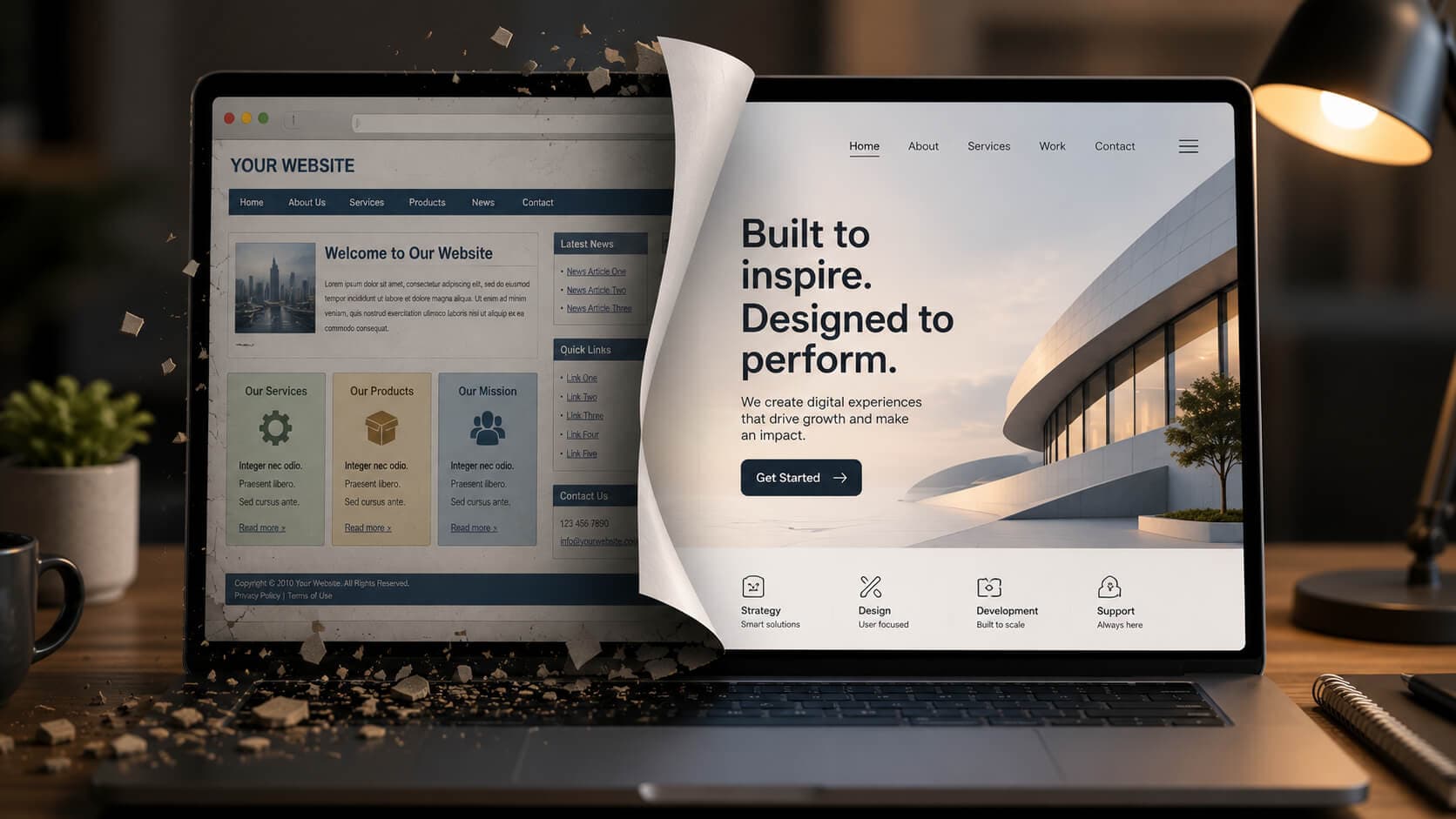
Design expectations change. An outdated website can make a business look less active, less professional, or less credible, even when the company itself is strong.
A redesign can modernize the visual system, improve hierarchy, and make the brand feel more aligned with its current position.
An outdated website does not only affect appearance. It affects trust. Visitors often judge a business quickly based on the quality of its digital presence. If the design feels old, unclear, or inconsistent, people may assume the company is less active or less prepared than it actually is.
This is especially important when customers compare several businesses at once. If competitors have clearer websites, stronger pages, faster experiences, and more professional layouts, an older website can make the business feel less competitive before anyone speaks to the team.
A redesign helps update the first impression. It can make the website feel more current, more organized, and more connected to the company’s real level of service. It can also create a stronger connection between the brand identity and the way the business wants to be seen today.
The Site Is Difficult to Use
If visitors struggle to find services, contact information, proof, pricing guidance, or next steps, the website is creating unnecessary friction.
Good website structure helps users move naturally from interest to understanding to action.
A website may look polished but still be difficult to use. If the menu is confusing, important pages are hidden, the content is not grouped clearly, or the user has to click too many times to find basic information, the experience becomes frustrating.
Visitors usually do not want to work hard to understand a business. They want a clear path. They want to know where to go, what to read, and what action to take. If the structure is weak, they may leave even if the service is relevant.
Good navigation should make the website feel simple. Services should be easy to find. Contact options should be visible. Supporting proof should appear where visitors naturally need reassurance. The user journey should feel guided, not random.
A redesign can rebuild the structure around how people actually use the website. Instead of organizing pages only around internal company categories, the website can be structured around visitor needs, questions, and decision points.
Mobile Performance Is Weak
A website that works poorly on mobile can lose a large share of potential customers. Small text, broken layouts, slow loading, cramped buttons, and long forms all affect results.
Modern website redesign should treat mobile experience as a core requirement, not a final adjustment.
Many users first visit a website from a phone. They may come from Google search, Instagram, LinkedIn, WhatsApp, email, or a digital ad. If the mobile version feels slow, crowded, or difficult to use, the visitor may leave before exploring the business properly.
Mobile experience is not only about making the desktop website fit on a smaller screen. It requires a different way of thinking. Content needs to be easier to scan. Buttons need to be comfortable to tap. Forms need to be shorter and simpler. Sections need to appear in a logical order.
A page that feels clean on desktop can become too long or confusing on mobile if it is not planned properly. Large images, long paragraphs, heavy animations, and complex layouts can make the mobile experience feel heavy.
A redesign gives the business a chance to make mobile performance stronger from the beginning. When the mobile journey is fast, focused, and easy to use, visitors are more likely to stay, read, and take action.
The Website Does Not Reflect Your Brand
If your business has changed but the website has not, visitors may receive the wrong impression. New services, stronger positioning, improved work, and a more mature brand should be visible online.
This connects with brand identity systems that keep digital communication aligned with the business.
A website should reflect the business as it is today, not the business as it was years ago. Many companies grow, improve, and reposition, but their websites continue to communicate an older version of the brand.
This can create a gap between reality and perception. The company may now offer stronger services, serve better clients, or have more professional processes, but visitors may not see that clearly online. If the website looks smaller than the business, it may reduce trust and weaken the first impression.
Brand alignment is especially important when the website is connected to sales, recruitment, partnerships, or paid campaigns. Every visitor should feel that the website matches the quality of the company.
A redesign can update the tone, visuals, content, page structure, and service presentation so the website feels aligned with the current brand. It can also help make the business easier to understand across all digital touchpoints.
SEO and Conversion Are Underperforming
A redesign may be needed when pages are not structured for search, content is thin, technical issues block visibility, or calls to action are weak.
Redesign should not only make the site look better. It should improve content structure, speed, internal navigation, tracking, and conversion paths.
A website that looks good but does not perform can still hold the business back. If pages are not ranking, visitors are not converting, or users are leaving before taking action, the issue may be deeper than design.
SEO and conversion should be part of the redesign strategy from the beginning. Page titles, headings, internal links, service pages, metadata, loading speed, and technical structure all affect how well the website can perform in search. If these elements are ignored, the redesign may look better but fail to improve results.
Conversion also depends on clarity. Visitors need to understand the offer, see trust signals, compare services, and know what to do next. If the calls to action are weak, hidden, or inconsistent, the website may lose leads even when traffic is strong.
A strategic redesign connects SEO and conversion together. It helps the website attract the right visitors and guide them toward meaningful actions.
The Content No Longer Supports the Decision
A website redesign is often needed when the content no longer explains the business clearly. The design may be outdated, but the words can be outdated too.
If the website uses generic copy, old service descriptions, unclear headlines, or weak proof, visitors may not understand why they should choose the business. Strong content should answer real questions and help people move closer to a decision.
This includes explaining who the service is for, what problem it solves, what process the company follows, what proof supports the claim, and what the visitor should do next.
A redesign is a good opportunity to rebuild content with more intention. Instead of only moving old text into a new layout, the business can improve messaging, service pages, page hierarchy, and calls to action.
When content and design work together, the website becomes more persuasive. It does not only look better. It communicates better.
The Website Feels Disconnected From Marketing
A website should support marketing efforts across channels. If the business is running Google Ads, social media campaigns, SEO, email marketing, or referral campaigns, the website should continue the same message after the visitor clicks.
When marketing and website experience do not match, visitors can feel confused. An ad may promote one message, but the landing page may feel general. A social media post may create interest, but the website may not provide enough proof. An SEO result may promise a topic, but the page may not answer it clearly.
A redesign can improve this connection. It can create stronger landing pages, clearer service pages, better internal journeys, and more focused conversion paths. This helps marketing channels become more effective because visitors land on pages that support their intent.
For businesses in London, this is important because digital competition is not only about attracting attention. It is about turning attention into trust and action.
The Website Is Difficult to Manage
Sometimes the problem is not only what visitors see. It is also what the internal team struggles with behind the scenes.
If updating the website is difficult, adding new pages takes too long, content changes require constant technical support, or the system is not flexible enough, the website may slow down marketing and business growth.
A modern website should be easier to maintain. Teams should be able to update content, add services, publish blogs, change images, review forms, and manage key sections without unnecessary friction.
A redesign can improve the backend structure as well as the frontend experience. A better website system helps the business stay active, publish faster, and keep information accurate.
This matters because a website is not a one time project. It should continue to support the company as services, campaigns, and business goals evolve.
Expert Perspective from The iBoost
At The iBoost, we approach redesign as a strategic rebuild of the website experience. We look at design, content, SEO, speed, mobile usability, service structure, and conversion together.
Through website redesign and development services focused on stronger user journeys and business performance, The iBoost helps companies turn outdated websites into clearer, faster, and more effective digital platforms.
If your website no longer represents the business or helps visitors take action, redesign may be the right next step.
A strong redesign should begin with diagnosis. Before changing visuals, it is important to understand what is not working. Are visitors leaving too quickly? Are important pages hidden? Is the mobile experience weak? Are service pages unclear? Is SEO underperforming? Are calls to action failing to guide users?
Once these questions are answered, redesign becomes more strategic. The goal becomes improving the complete journey, from first impression to final action.
For businesses in London, the website can be one of the most important digital assets. It supports credibility, search visibility, paid campaigns, brand perception, and lead generation. When the website works properly, it strengthens every channel connected to it.
A website redesign is not only about a fresh look. It is about building a stronger digital platform that reflects the business clearly, supports growth, and gives visitors a better reason to trust and act.
Frequently Asked Questions
You may need a redesign if your website looks outdated, loads slowly, performs poorly on mobile, confuses visitors, or no longer supports your goals.
Yes. A redesign should protect and improve SEO through better structure, speed, content, metadata, technical health, and internal linking.
No. Website redesign should improve content, user experience, navigation, mobile usability, performance, and conversion paths.
Yes. An outdated or difficult website can make a business feel less active, less credible, or less aligned with customer expectations.
The iBoost reviews design, content, SEO, speed, mobile experience, and conversion goals to rebuild a clearer and more effective website.