| Sydney, Australia - May 15, 2026
How Search Intent Shapes Better SEO Content in Sydney
SEO content should not start with keywords alone.
It should start with understanding what users actually want when they search. A keyword tells you what someone typed, but search intent explains why they typed it. When content matches that intent, it becomes more useful, more relevant, and more likely to perform in search results.
For businesses operating in Sydney, understanding search intent helps create SEO content that attracts the right visitors and supports better digital performance. In Sydney market, users search with different goals, so content must answer the reason behind the search, not only include the keyword.
This is why businesses invest in search engine optimization strategies that align content with search intent, relevance, and organic visibility.
Better SEO content begins with intent.
Not just keywords.
What Search Intent Means
Search intent is the purpose behind a user’s search.
It explains what the user wants to achieve after typing a query into a search engine.
A user may want to:
- learn something
- compare options
- solve a problem
- find a service
- buy a product
- check prices
- understand a process
- find a local business
- make a decision
- complete an action
Search intent helps businesses understand the real need behind the search.
When content answers that need clearly, it becomes more valuable.
Why Search Intent Matters for SEO Content
Search intent matters because search engines aim to show results that satisfy users.
If a page targets the right keyword but answers the wrong need, it may fail to rank or fail to convert.
Search intent helps businesses:
- create more relevant content
- improve ranking potential
- reduce bounce rates
- increase engagement
- answer user questions clearly
- support better conversions
- improve content structure
- attract higher quality traffic
For businesses in Sydney, intent-led content helps reach users at the right stage of the journey.
The goal is not only to attract traffic.
The goal is to attract the right traffic.
Keyword-Based Content vs Intent-Based Content
Keyword-based content focuses mainly on the phrase.
Intent-based content focuses on the user’s goal.
The difference is clear:
- keyword-based content may repeat terms
- intent-based content answers real needs
- keyword-based content can feel shallow
- intent-based content feels useful
- keyword-based content may attract the wrong traffic
- intent-based content attracts better visitors
- keyword-based content focuses on ranking
- intent-based content supports ranking and conversion
- keyword-based content may miss context
- intent-based content builds relevance
Keywords still matter.
But intent gives keywords meaning.
Main Types of Search Intent
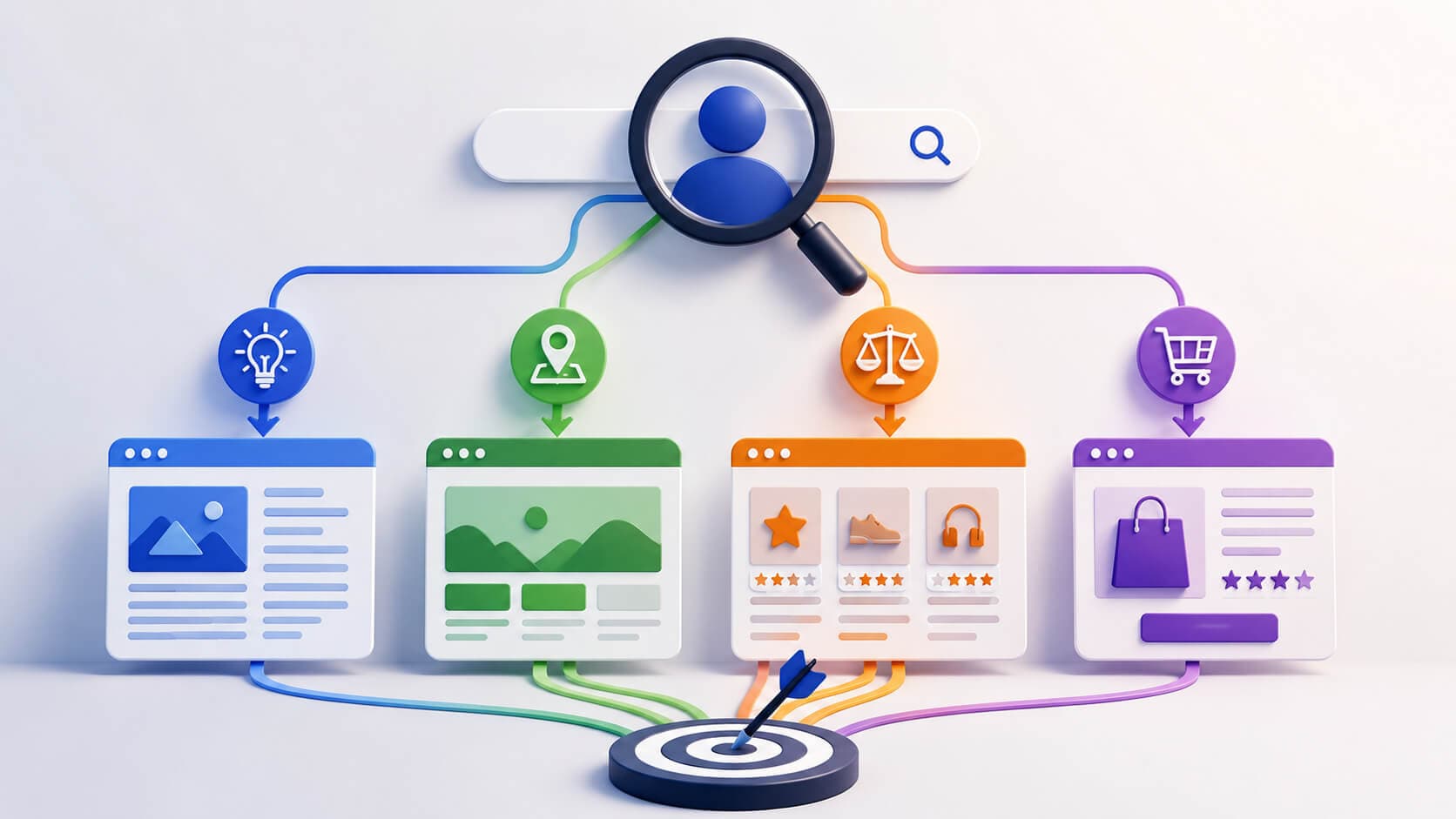
Understanding the main types of search intent helps businesses create better SEO content.
Informational Intent
Informational intent happens when users want to learn.
They may search for definitions, guides, explanations, or answers.
Examples include searches like:
- what is search intent
- how SEO content works
- why website speed matters
- how to improve product pages
Content for informational intent should educate clearly.
It should explain the topic and answer common questions.
Commercial Intent
Commercial intent happens when users are researching before making a decision.
They may compare services, evaluate providers, or look for the best option.
Examples include:
- best SEO agency
- SEO services for businesses
- content marketing vs paid ads
- website design company comparison
Content for commercial intent should build trust and help users compare.
It should explain value, differences, and decision factors.
Transactional Intent
Transactional intent happens when users are ready to take action.
They may want to buy, book, sign up, request a quote, or contact a provider.
Examples include:
- hire SEO agency
- book website design service
- buy e-commerce website package
- request digital marketing proposal
Content for transactional intent should make the next step clear.
It should reduce friction and guide users toward action.
Navigational Intent
Navigational intent happens when users are looking for a specific brand, page, or platform.
Examples include:
- The iBoost SEO services
- The iBoost blog
- Instagram business manager
- Google Search Console
Content for navigational intent should make it easy for users to reach the correct destination.
It should be clear and direct.
How Search Intent Shapes Content Strategy
Search intent helps decide what kind of content should be created.
A business should not treat every keyword the same way. Some keywords need a blog post. Others need a service page, product page, landing page, comparison page, or guide.
Intent can shape:
- page type
- content depth
- headline structure
- call to action
- internal links
- examples
- tone
- information order
- content format
- user journey
This connects with content strategy development that aligns topics, messaging, and user intent.
When content format matches intent, the page becomes more useful.
Useful content performs better.
Search Intent and Page Structure
Search intent should influence how a page is structured.
If users want a quick answer, the page should be direct. If users want a detailed guide, the page should provide depth and structure.
Good page structure can include:
- clear introduction
- direct answer
- organized headings
- helpful explanations
- examples
- comparison sections
- common mistakes
- frequently asked questions
- clear next step
A page should guide users naturally.
The structure should match what the user came to do.
Search Intent and Content Depth
Not every search needs the same level of depth.
Some searches require a short explanation. Others require a complete guide.
Content depth should depend on:
- user knowledge level
- complexity of the topic
- decision stage
- competition level
- type of query
- expected answer
- business goal
A shallow page may fail when users need detail.
A long page may fail when users need a quick answer.
The best content gives the right amount of information.
Search Intent and User Journey
Search intent reflects where the user is in the journey.
Some users are just learning. Others are comparing. Others are ready to act.
SEO content should support each stage.
Awareness Stage
Users want information.
Content should educate, explain, and build trust.
Consideration Stage
Users are comparing options.
Content should show value, differences, benefits, and proof.
Decision Stage
Users are ready to act.
Content should provide clear calls to action, trust signals, and simple next steps.
This aligns with digital marketing strategies that connect content intent with audience journeys and measurable outcomes.
Matching content to the journey improves both visibility and conversions.
Search Intent and Keyword Research
Keyword research becomes stronger when search intent is considered.
Instead of collecting keywords only by volume, businesses should group keywords by purpose.
A strong keyword strategy should consider:
- what users want
- what stage they are in
- what content type they expect
- how competitive the search is
- what questions they ask
- what related terms support the topic
- what conversion opportunity exists
High volume keywords are not always the best keywords.
Intent determines value.
Search Intent and Headings
Headings should reflect the questions and needs behind the search.
Strong headings help users scan the page and help search engines understand the content.
Intent-based headings can:
- answer common questions
- organize subtopics
- guide the reader
- improve readability
- include related search phrases naturally
- support topic relevance
Headings should not be written only for keywords.
They should help users move through the content.
Search Intent and Calls to Action
The call to action should match the user’s intent.
A user who wants information may not be ready to request a proposal immediately. A user comparing services may need a consultation or service page. A user ready to buy needs a direct action.
Calls to action can include:
- learn more
- explore services
- request a quote
- book a consultation
- download a guide
- contact the team
- view case studies
- compare options
The right call to action improves the user journey.
The wrong call to action can feel too early or irrelevant.
Search Intent and Internal Linking
Internal links should guide users based on their intent.
If a user is reading an educational blog, internal links can guide them to related articles or service pages. If a user is on a service page, links can guide them to proof, case studies, or contact forms.
Internal linking helps:
- improve navigation
- support topic clusters
- guide users to the next step
- improve crawlability
- connect content to services
- strengthen SEO structure
This aligns with website development strategies that improve structure, navigation, and SEO performance.
Internal links should feel helpful and natural.
They should support what the user is likely to need next.
Common Search Intent Mistakes
Many businesses create content that targets keywords but misses intent.
Common mistakes include:
- writing a blog when users expect a service page
- creating a sales page when users want education
- using the wrong call to action
- ignoring the user journey
- targeting high volume keywords without context
- writing shallow content for complex topics
- writing long content for simple queries
- ignoring related questions
- copying competitor structure without strategy
- not updating content when search behavior changes
These mistakes reduce ranking and conversion potential.
Intent helps prevent them.
How to Identify Search Intent
Businesses can identify search intent by studying how users search and what search results show.
Useful steps include:
- review the search results
- look at the top-ranking page types
- study common headings
- check related questions
- analyze competitor content
- identify repeated themes
- consider the user journey
- review customer questions
- compare informational and commercial signals
If most top results are guides, users likely want information.
If most top results are service pages, users may be ready to act.
Search results reveal what users expect.
Search Intent and Content Updates
Search intent can change over time.
A keyword that once needed a simple article may later require deeper content, new examples, or a different format.
Content should be reviewed regularly to ensure it still matches intent.
Updates can include:
- improving introductions
- adding missing sections
- changing page structure
- updating calls to action
- adding frequently asked questions
- improving internal links
- refreshing examples
- expanding content depth
- adjusting titles and descriptions
SEO content should evolve with user behavior.
A page that matched intent last year may not fully match it today.
When Businesses Should Improve Search Intent Alignment
Businesses should improve search intent alignment when content gets traffic but does not perform well.
This is especially important when:
- pages rank but do not convert
- users leave quickly
- engagement is low
- content attracts the wrong audience
- service pages get weak leads
- blogs do not support business goals
- competitors rank with more relevant pages
- search behavior changes in Sydney
- content feels outdated
Improving intent alignment can make existing content more effective.
Sometimes the keyword is right, but the content angle is wrong.
Strategic Reality Behind Search Intent
Search intent is not just an SEO detail.
It is the connection between what users want and what businesses publish.
A strong SEO content strategy should answer:
- why is the user searching?
- what stage of the journey are they in?
- what answer do they expect?
- what format would help them most?
- what questions should the content answer?
- what next step makes sense?
- how does the page support business goals?
- how can the content remain useful over time?
When these questions guide content creation, SEO becomes more strategic.
Intent turns content into a better user experience.
Real World Application
A business in Sydney using search intent to shape SEO content can improve visibility and content performance.
Search intent can help the business:
- create more relevant pages
- attract better traffic
- improve engagement
- reduce bounce rates
- increase conversions
- support stronger service pages
- build topic authority
- improve long-term rankings
For example, instead of creating one general article around a keyword, a business can identify whether users want education, comparison, or action. Then it can create the right page type with the right structure and call to action.
This creates content that better matches user expectations.
Search Intent and SEO Growth
Businesses scaling in Sydney, including Central Business District, North Sydney, Parramatta, Chatswood and beyond, benefit from SEO content that is shaped by intent.
As competition increases, content that only includes keywords becomes less effective. Pages need to answer the right need in the right format.
Search intent supports SEO growth by helping businesses create:
- stronger relevance
- better organic visibility
- higher quality traffic
- clearer content journeys
- stronger user engagement
- better conversion opportunities
- more useful topic clusters
- long-term content value
Growth needs content that answers real search needs.
Search intent makes that possible.
Expert Perspective from The iBoost
At The iBoost, we build SEO content strategies that start with user intent.
We help businesses understand what their audience is searching for, why they are searching, and what type of content can best answer that need.
Through search engine optimization strategies that align content with search intent, relevance, and organic visibility, we help businesses create stronger content across Sydney.
Search intent shapes better SEO content because it connects keywords with real user needs.
For businesses in Sydney, intent-led content can improve relevance, visibility, engagement, and long-term organic growth.
Frequently Asked Questions
Search intent is the reason behind a user’s search. It explains what the user wants to learn, compare, solve, find, or do.
Search intent matters because content that matches the user’s goal is more useful, more relevant, and more likely to perform in search results.
The main types are informational intent, commercial intent, transactional intent, and navigational intent.
Businesses can identify search intent by reviewing search results, studying top-ranking page types, checking related questions, analyzing competitors, and understanding customer needs.
Search intent improves conversions by matching the content, structure, and call to action with the user’s stage in the journey.